GET calls in output mode use the time and last_update parameters, which accept a value in UNIX format.
The combination of both parameters lets you extract the information between last_update and time.
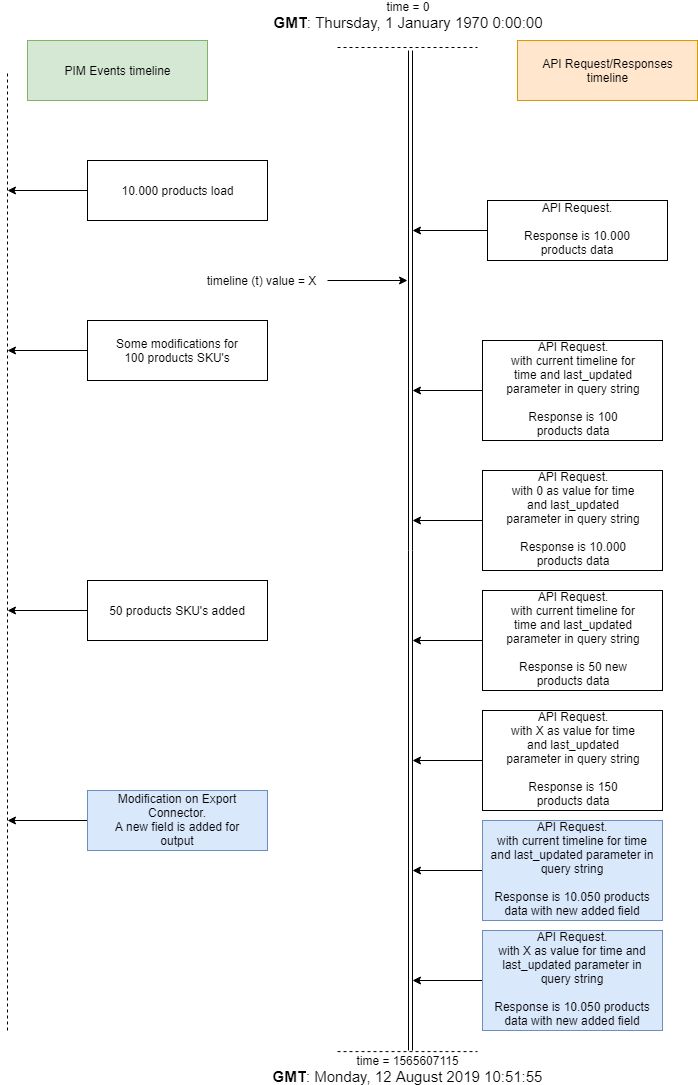
General behavior
The data response follows a logic based on the time parameters sent.
- You can get all items traveling through the connector if you send a time equal to
0. - Any change in the connector configuration or its parameters will trigger a full synchronization.
The Sales Layer SDK, based on LAMP technology, lets you create local data repositories through the Updater SDK service. This makes it easier to synchronize the PIM with a database.
The Sales Layer PHP SDK is available on GitHub.
Export parameterization
Export connectors let you define how the API output behaves depending on the status of items in the different PIM tables.
You can also select the locales enabled in the account to extract translation values from fields configured as multilingual.
In addition, you can configure combinations of statuses for record output, for example: All, Visible, or Visible + Draft.
Category export can also include empty categories if you enable the Include empty categories parameter.
You can also filter the content of each table using tags, formulas, or search filters.
Hierarchy between tables
The Categories, Products, and Variants tables share a hierarchical relationship. Because of that, a change in one of them can affect the next ones, as long as those tables are active in the connector.
Any Custom Entity tables remain outside this hierarchy.
For example, if you change the status of a category that has associated products, the API can generate a modification (M) or deletion (D) output for those products, even if no direct change was made to them. If those products have associated variants, the API will also send change information for those variants.
The combination of parameters such as parents_category_tree, first_parent_level, and same_parent_variants lets you adapt the behavior of the information sent by the API during extraction processes so it fits different external application requirements.
Was this article helpful?
That’s Great!
Thank you for your feedback
Sorry! We couldn't be helpful
Thank you for your feedback
Feedback sent
We appreciate your effort and will try to fix the article